Edwin Langley - Software Developer
Jump, Break and Miscellaneous Statements
Jump, Break and Miscellaneous Statements
Jump Statements
There are four main jump statements in C#. Jump statements tell execution to jump to a specific point rather than necessarily being associated with a code block.
Break
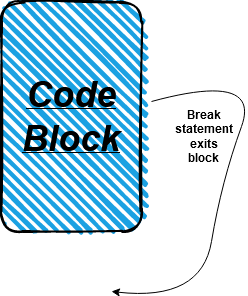
The break statement dictates that the execution should leave the current code block. We saw this earlier in the case of a switch statement where it did not make sense to evaluate the other cases so instead, we broke out of the switch statement.
using System;

public class Program
{
	public static void Main()
	{
		int i = 4;

		addOneToi:
		if(i<9)
		{
			i++;
			Console.WriteLine(i);
			goto addOneToi;
		}

		Console.WriteLine("End of execution");
	}
}
Continue
The continue statement is specific to loops. When a continue statement is encountered, the remaining statements in the loop are not executed and the loop will proceed to the next iteration.
                    using System;

public class Program
{
	public static void Main()
	{
		for(var i = 1; i < 20; i++)
		{
		 	if(i%2==0)
				continue;
			else
				Console.WriteLine(i.ToString());
		}
	}
}
goto
The goto statement will move execution to a specified label or switch case.
A label is an identifier that is followed by a semicolon and specifies a significant point in the code.
using System;

public class Program
{
	public static void Main()
	{
		int i = 4;

		addOneToi:
		if(i<9)
		{
			i++;
			Console.WriteLine(i);
			goto addOneToi;
		}

		Console.WriteLine("End of execution");
	}
}
Return
The return statement ends the method and will return a value to where it was called from. The return keyword is only valid if the statement is not void.
using System;

public class Program
{
	public static int return1()
	{
		return 1;
	}
}
A return statement does not have to be at the end of a method, it could exist within a select statement. However, a return statement must always eventually be hit for a non-void method.
Throw
Throw statements generally suggest that an error has occurred within the application. We will visit this topic in more depth in a later tutorial when we discuss errors and the measures we can take to mitigate their impact.
Using Statement
The using statement is used when you only want an object to exist for a small, set number of statements, after which point the object will be disposed of.
                    using System;
public class Program
{
	public static void Main()
	{
		//using(exampleClass s = new exampleClass())
		//{
		//    s.methodExample(s);
		//}
	}
}